Please do not use "post comments" to ask for camera help and advice.
Use phone, Skype IM or eMail.

Sunday, 1 January 2012

Remote camera results for December 2011

Camera trap location 1
This year, although I'll still be surveying red squirrels, I'm also going to be setting camera traps through a cross section of the glen, in the hope of finding evidence of wildcat.

I've already seen a large cat hunting a hare which, although I couldn't verify this at the time, may well have been a hybrid if not a pure wildcat. I've also found other signs which suggest at least one large cat in this area and I'm eager to prove it one way or the other.

Sitka Spruce cone predation by Red Squirrel
The camera I've chosen to use is the Ltl Acorn 5210A 940nm and for the last couple of months I've been testing a number of these in different environmental conditions to get to know their operational parameters.

So far they're proving to be a good choice, not least because they're about half the price of any other comparable camera; and on my budget that's an important consideration. I'll post more about their performance at a later date.

Roe Deer
The location pictured above left is adjacent to a deer trail and I also noticed squirrel feeding signs close by, so I set two cameras, positioned at different angles across the trail. One covered the area where the squirrel had been feeding and the other covered a large stump, baited with meat and bone.

(I made a mistake with the menu settings on one camera so the moon, date and time info' is incorrect)


The images on the left and below show a selection of the results over a ten day period in December.

Common Buzzard 
Red Fox
The final tally was Chaffinch, Robin, Jay, Hooded Crow, Common Buzzard, Roe Deer, Red Fox, Red Squirrel and Pine Marten.

The image of the Buzzard (left) is an enlargement from the centre of the frame.

The image of the Red Squirrel (bottom) is from the camera with the correct moon phase, date and time settings and it's worth noting that with shots like this, where the animal is moving quickly across the frame and close to the camera, I wouldn't normally expect to get a record; because the animal would be gone before the camera triggered.

I would hope that this is an indication of the effectiveness of the side prep sensors which, at this time, are unique to these cameras.

Both cameras were set to shoot firstly a still image and then video; and by the time the video started the squirrel was nowhere to be seen.

I'll post a video composite tomorrow as an example.


Red Squirrel

Rain, snow and a lot of water - Happy new year


My recollection of 2011 is going to be rain, snow, ice, mud and a lot of water. While the south of the UK has been worrying about drought, this part of the country has been suffering from a significant lack of sunshine.

Unlike the last two winters, which went straight to snow for long periods, this year the snow came a little earlier, stayed for a couple of weeks and now we're back to guess what. RAIN!


Still, at least the days are getting longer now. Happy new year.

Tuesday, 13 December 2011

BBC News - Concern over squirrel pox at Culzean Country Park


Red Squirrel

"Concern is growing for Scotland's red squirrel population after a case of deadly squirrel pox was confirmed at Culzean Country Park in Ayrshire."


"The virus was found in a grey squirrel, which is unharmed by the pox, but can pass it on to red squirrels.
Until now, cases had largely been confined to the far south of Scotland.
The National Trust for Scotland (NTS) said the presence of the pox virus in Ayrshire "represents a concerning leap to the north".


Squirrel pox was detected at Culzean by NTS rangers and staff from the Red Squirrels in South Scotland Project. It was later confirmed by expert testers."
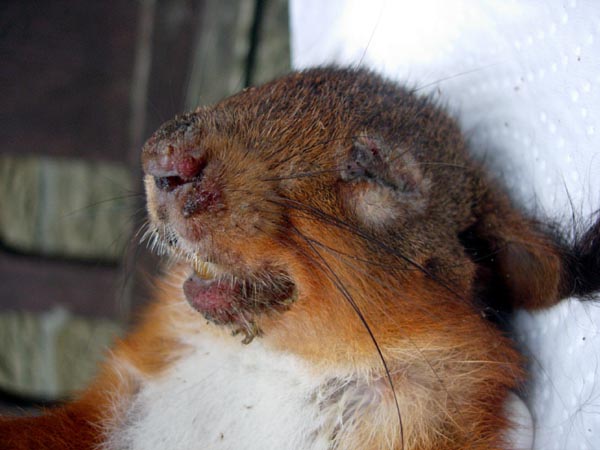
The disease is almost always fatal to Red Squirrels. It causes lesions around the mouth, nose and eyes similar to Myxomatosis in Rabbits and usually kills the squirrel in 7 to 10 days.


Click the link below to read the rest of the story.


The squirrel pox virus (squirrel parapoxvirus) is believed to be transmitted from grey to red squirrels by parasites in dreys and by contact at feeding sites. 

Because of the latter, people are being advised not to provide squirrel feeders in areas where red and grey squirrels are both present.

Read a full report about this by clicking the link below.

Lesions to the eyes, nose and mouth of a red squirrel, caused by the squirrel pox virus

Friday, 9 December 2011

Scottish Wildcat (Felis sylvestris grampia)

Click here to visit the Scottish Wildcat Association
I mentioned before that I was planning to get more involved in Scottish Wildcat conservation and this winter I will be setting camera traps in the hope that I can gather evidence of their presence.

In late summer 2010 I witnessed a large cat stalking a hare at night which, at a distance, looked very much like a wild cat; but there was no way of establishing if it was pure bred, hybrid or a feral cat.

I've also seen foot prints and faeces on several occasions since which lead me to believe they are about in this area.

The Scottish Wildcat Association is a charitable organisation dedicated to protecting and conserving Britain's only remaining wild feline and through their wildcat haven project are working hard, not only to improve this cat's chances of survival long term but also its population expansion into areas from which it has disappeared.

Click here to visit the Scottish Wildcat Association


If you care about the plight of the Scottish Wildcat you can help either as a volunteer or with fund raising by becoming a member of the association.

Wednesday, 30 November 2011

Camera survey of a local spruce plantation.

Norway Spruce plantation

Norway Spruce canopy
I was recently asked to carry out a survey for Red Squirrels and their dreys (nests) in a local plantation of dense Norway Spruce.

This is an area which normally shows a fairly high incidence of squirrel feeding during the late summer and autumn but the most recent signs I found were at least a month old and mostly green cone feeding from summer and early autumn.

This year has been extremely wet in this area and coupled with an almost non existent hazel crop, it's possible that mortality may be higher than normal.

I've looked, many times for dreys in this plantation and so far had not seen any. This occasion was no exception and as you can see from the images on the left, the tree density makes it an almost impossible task.

Fungi 
I used trail cameras in several places in the hope that one of them might catch a squirrel. In one part of the plantation where the most recent feeding signs were found I also discovered a group of fungi, which some animal had been feeding on. In the hope of finding out what, I set two of the cameras at different angles over these.

The other cameras I set nearby for several days but still no squirrels.

When I returned to collect the cameras I saw      where badgers had been turning the ground for earthworms and as you can see in the video composite below, the area was visited by a fox, two badgers and a Pine Marten in a hurry.

The light in the marten shot is the second camera firing. Both cameras are 'black flash' so this is just what the camera can see.

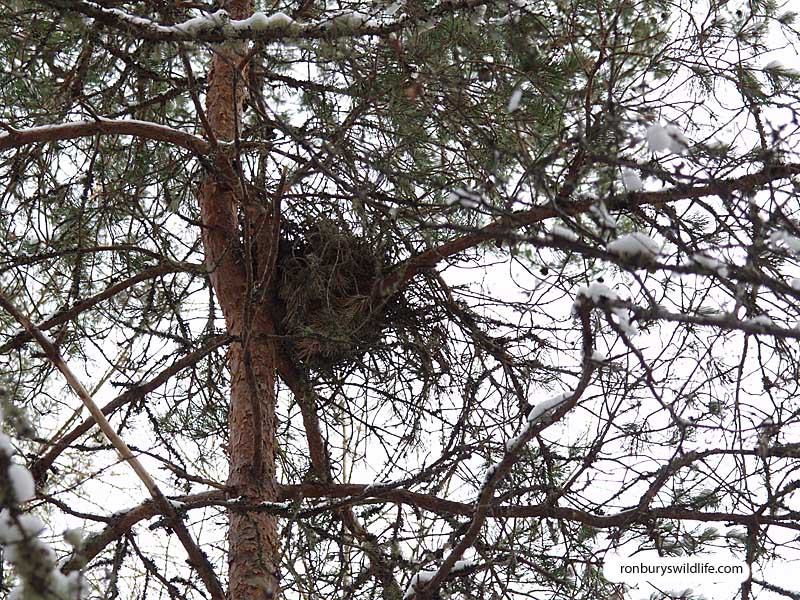
There are also two images of Red Squirrel dreys shown below for reference. These are both about 10 metres of the ground. They are not always this visible.


Red Squirrel drey in Scots Pine


Red Squirrel drey in Norway Spruce

Monday, 28 November 2011

Dog Falls and Loch Beinn a' Mheadhain in Glen Affric

Dog Falls
A happy Kathy with the dogs, under an old Scots Pine
A week last Friday, Kathy and I decided to take the dogs round to Dog Falls in Glen Affric and walk up to a view of Loch Beinn a' Mheadhain.

The day was overcast and threatening rain but only managed wind and a light drizzle. From the viewpoint I took a shot of Loch Beinn a' Mheadhain (pronounced - ben a veyan) under a dark sky and then we diverted up the hill into some sheltered Pines for a brew up before returning.

We saw Woodcock which migrate here for the winter and somewhere on the hill above we heard a deer whistle an alarm call.

Happy days.

Loch Beinn a' Mheadhain looking west from above the dam


Wednesday, 16 November 2011

Guisachan Farm - Sunset, Moonrise and Autumn

Guisachan Farm - November sunset
Moonrise over the old Guisachan House ruin
Autumn colours on the hillside above  Guisachan Farm

Tuesday, 8 November 2011

The Porsche Cayennes of Larissa | Habitat Aid's Blog

This topical comment on the Greek economy and its parallels in conservation, by Nick Mann at Habitat Aid is well worth a read.

The Porsche Cayennes of Larissa | Habitat Aid's Blog:

Monday, 7 November 2011

Trees for Life 2012 Calendar

This last weekend I was horrified to discover that I had accidentally scrambled the trees for life link code (top of right hand sidebar) and the link was sending everyone to a completely different site; so as part of my apology to them I thought I'd promote their 2012 calendar.


This year they've changed the calendar to focus exclusively on the Caledonian Forest, and it features outstanding photographs of the trees and wildlife there, together with thoughtful quotes about forests and the importance of volunteering. Beautifully produced to a high standard, it includes plenty of space for appointments and will provide inspiration all year long.


Order your 'Trees for Life' 2012 calendar

Tuesday, 1 November 2011

Trail camera colour balance, sharpness and dynamic range

Fig 1. Acorn full frame
Fig 2. Acorn centre frame
All these images are shot at the same time so conditions for each camera are identical.

I deliberately included a fair amount of sky in the frame to push the dynamic range.
Click an image to open in a new window.


Fig 3. Bushnell full frame
Fig 4. Bushnell centre frame

Colour balance.

The Bushnell is warmer than natural, while the Acorn is slightly cool and the Prostalk much cooler than natural.


Fig 5. Prostalk full frame
Fig 6. Prostalk centre frame
Dynamic range.

The Bushnell dynamic range is by far the best but darker than I would prefer.
The Acorn looses some sky detail and the Prostalk performs poorly with noticeable blue fringing.

Sharpness and clarity.

The Bushnell again performs best while the Acorn is soft in the centre frame image (fig 2). The Prostalk looks sharp in the full frame image (fig 5) but shows the pixels significantly breaking down in the centre frame image (fig 6).

Overall performance.


1 Bushnell   2 Acorn   3 Prostalk

Cameras under test are
 Acorn 5210A 940nm, Bushnell Trophy Cam 2010 model 119445 and Hawke ProStalk PC2000
Related Posts Plugin for WordPress, Blogger...
This web site is about the wildlife, particularly the mammals, of the Glen Affric National Nature Reserve area in the north west Highlands of Scotland, UK; and the equipment I use to search for them, which is chiefly trail cameras.

I provide a technical support and parts service for the Ltl Acorn range of cameras and the income from this provides for the upkeep of this site and the purchase of cameras for my own surveying.

I hope you find the site useful and informative; and please contact me if you have any questions that I haven't already covered.