Please do not use "post comments" to ask for camera help and advice.
Use phone, Skype IM or eMail.

Showing posts with label fox. Show all posts

Wednesday, 30 November 2011

Camera survey of a local spruce plantation.

Norway Spruce plantation

Norway Spruce canopy
I was recently asked to carry out a survey for Red Squirrels and their dreys (nests) in a local plantation of dense Norway Spruce.

This is an area which normally shows a fairly high incidence of squirrel feeding during the late summer and autumn but the most recent signs I found were at least a month old and mostly green cone feeding from summer and early autumn.

This year has been extremely wet in this area and coupled with an almost non existent hazel crop, it's possible that mortality may be higher than normal.

I've looked, many times for dreys in this plantation and so far had not seen any. This occasion was no exception and as you can see from the images on the left, the tree density makes it an almost impossible task.

Fungi 
I used trail cameras in several places in the hope that one of them might catch a squirrel. In one part of the plantation where the most recent feeding signs were found I also discovered a group of fungi, which some animal had been feeding on. In the hope of finding out what, I set two of the cameras at different angles over these.

The other cameras I set nearby for several days but still no squirrels.

When I returned to collect the cameras I saw      where badgers had been turning the ground for earthworms and as you can see in the video composite below, the area was visited by a fox, two badgers and a Pine Marten in a hurry.

The light in the marten shot is the second camera firing. Both cameras are 'black flash' so this is just what the camera can see.

There are also two images of Red Squirrel dreys shown below for reference. These are both about 10 metres of the ground. They are not always this visible.
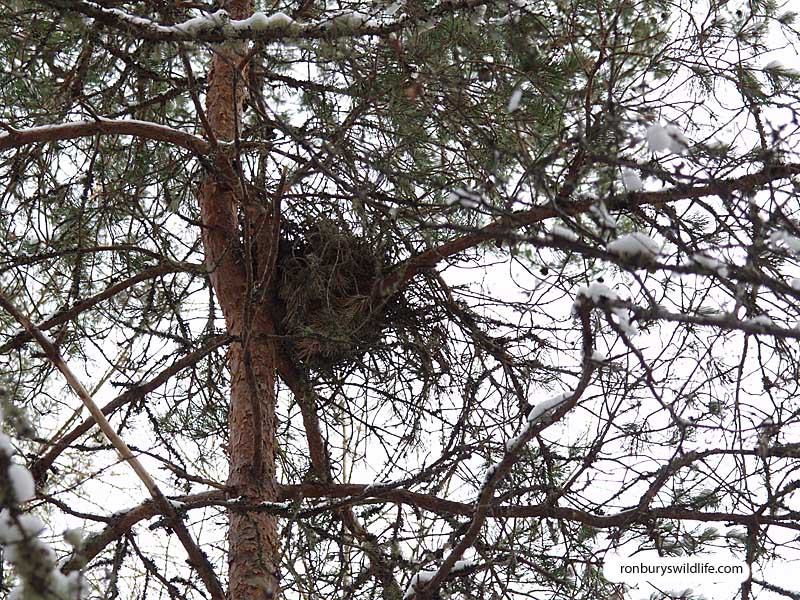


Red Squirrel drey in Scots Pine


Red Squirrel drey in Norway Spruce

Friday, 14 October 2011

Wildlife reactions to trail cameras

Following on from the last post, I had the ProStalk set up over peanuts in the same area and as well as the squirrel, this was visited by badger and pine marten.

The video clip below shows a badger taking notice of the visible infra red when the camera switched on. Badgers and pine martens don't seem at all bothered by this and after their initial interest, will carry on as normal. Almost invariably, pine martens will come and give the camera a close up inspection and on a number of occasions where the camera has been set close to the ground, they have marked the camera by urinating over it. The first time this happened I thought the camera was a bit sticky when I went to check the card, and afterwards, as I looked at the video clips, I realised why.

This is not the case with other wildlife. Red Deer will always be nervous and shy away from the camera if they come close or it is directly in their path. Urbanised foxes, although nervous, do seem to tolerate the IR glow after a while, but out here where foxes are really wild, all you'll usually see is the light in their eyes as they keep to the edge of the illuminated area and skirt round and away.


Close by another camera caught these Red Deer hinds and I think a yearling calf, in the early morning light.

Sunday, 3 April 2011

Who's living in this hole

At another forest location is an old disused Badger Sett which I've been keeping an eye on, and recently there has been some fresh digging at one of the entrance holes. This last week I decided to stake it out with the trail camera and see what might be visiting.

On the second night the hole was investigated about two hours apart by a Pine Marten and a Badger. Both animals entered the hole briefly but neither stayed for more than a few minutes.

There were no false triggers on the camera to suggest that anything had exited the hole and disappeared during the camera delay time and neither animal stayed long enough to indicate anything other than a passing interest.

For the moment I can only assume that the fresh digging is exploratory. Curiously a Fox was caught fleetingly at the edge of the light, just after 9pm on the third night, and as is usual with Foxes, was spooked by the IR. The slightest suggestion of anything out of place and the local Foxes just melt away. Again nothing to suggest it was using this hole as I would have expected it to be out earlier if it had been exiting the hole after laying up. Mind you, I still have a question mark over this as the delay time on the camera would miss a fast exit.

Just after 3pm on the second day the camera was triggered by Chaffinch's feeding on the ground around the entrance. Suddenly they were spooked by something and took off in a great hurry after which a wing briefly appeared in the right hand side of the frame. I've looked at this several times and I'm fairly certain it was a hunting Sparrowhawk but there's not enough visible to make posting the video clip worthwhile.

It did leave me wondering how often trail cameras catch this sort of event, especially as in this case, in a confined forest environment.

I've now moved the camera back to the other Sett where I'm hoping young will emerge during April but will check this hole from time to time.

Below is a brief clip of the Marten and Badger.


Who's living here from Ron Bury on Vimeo.
Related Posts Plugin for WordPress, Blogger...
This web site is about the wildlife, particularly the mammals, of the Glen Affric National Nature Reserve area in the north west Highlands of Scotland, UK; and the equipment I use to search for them, which is chiefly trail cameras.

I provide a technical support and parts service for the Ltl Acorn range of cameras and the income from this provides for the upkeep of this site and the purchase of cameras for my own surveying.

I hope you find the site useful and informative; and please contact me if you have any questions that I haven't already covered.