Please do not use "post comments" to ask for camera help and advice.
Use phone, Skype IM or eMail.

Showing posts with label red squirrels. Show all posts

Tuesday, 19 September 2017

Appeal to save ice age heritage of Scotland’s national tree

Dead Scots pine, or snag, silhouetted against shafts of
sunlight over Gleann na Ciche & Loch Affric
Trees for Life has launched an initiative to save ancient Scots pines across the Highlands of Scotland from becoming the last generation in a lineage of trees dating back to the last ice age.

Through its Caledonian Pinewood Recovery Project, the conservation charity wants to help restore 50 areas of remnant and neglected pinewoods – mainly made up of lone, ancient ‘Granny’ pines which are over 200 years old but dying as they stand, with no young trees to succeed them.

The fragments – scattered over a large area – face growing threats from overgrazing by deer, tree diseases and climate change, and are at risk of

Wednesday, 26 August 2015

New project seeks first major boost in Scotland’s red squirrel numbers in decades

Red squirrel © Peter Cairns www.northshots.com
An innovative new project by conservation charities Trees for Life and the Highland Foundation for Wildlife aims to secure a major increase in the range of Scotland’s red squirrel populations for the first time in decades.

The Caledonian Forest Wildlife Project – which launches this summer – has the ambitious goal of establishing 10 new populations of the species in the Highlands over the next three years, with the long-term aim of boosting red squirrel numbers in Scotland by more than 10 per cent. It will also provide a unique opportunity for volunteers, including those from remote communities, to take an active

Monday, 30 July 2012

Phantom Red Squirrel, Pine Marten and Red Deer.

Fast moving Red Squirrel travelling right to left.
Shutter speed was 1/25sec which was too slow to catch
anything other than the squirrels tail.
Notice the blond tail which is a fairly common feature of
red squirrels in this area of Scotland.
End of last week I collected several camera traps that had been set on forest deer trails. Red Deer are regularly culled to help forest regeneration in this area, which makes them nervous and elusive.

I was hoping to get an idea of how many animals were regularly in this section of forest and the video clips below follow on from my post a month ago.

Co-incidentally I discovered two obscure but identifiable reasons for apparent false triggering.

The image on the left is of a passing squirrel, which I nearly missed and the following video shows three frames taken with an Acorn 5210A camera trap, which captured a moving stick in the ground vegetation. Each frame is a centre crop of the

Tuesday, 20 March 2012

The Red and Grey Squirrel Dilemma

Much emotive nonsense has been written and spoken about this issue in recent times; and so to read the reasoned comment below was very refreshing. I feel it's so important these words are read by as many as possible, that I have included the full article in this post; and hope I wont be accused of any copyright transgression.

For my own part I would add that ecosystems take thousands of years to evolve and for humans to cherry pick a species from one system and dump it into another is, in my opinion, nothing short of a criminal act; and all on a whim of human self indulgence with no thought of the consequences.

It's time that we accepted our responsibility for the imminent destruction of yet another of our native species, stopped carping about the semantics, and at least try to do something about it. 

If you wish to read the article in its original context and possibly make your own comment, please go to www.scotsman.com


Gavin Whittaker: Red and grey squirrels are in a do or die contest 
Published in The Scotsman on Tuesday 20 March 2012 00:00
There has been a lot of debate about red and grey squirrels recently. Before jumping to conclusions, here are some facts about red squirrels. 
First, the red squirrel is found across the entire arboreal range of northern Europe and Asia, and it is ludicrous to suggest that the red squirrel, virtually alone among Eurasian mammals, would not also occupy Britain in the immediate post-glacial period, 10,000 years ago.
 Secondly, the subspecies found in Britain, Sciurus vulgaris leucourus, is peculiar to Britain and Ireland and first described by Scottish-born scientist Robert Kerr in 1792. Kerr considered S.v. leucourus separate from the European S.v.vulgaris due to the blanching of its tail during the summer. This was backed up by anatomist Jerzy Sidorowicz who also considered S.v. leucourus to be a valid subspecies based on a slightly shorter average skull height than S.v.vulgaris. It is not credible that the British subspecies would differ so much from the European farm stock, and from which some consider it to be derived, within 300 years of its supposed introduction.
 Thirdly, absence of evidence is not evidence of absence. Why would medieval writers concern themselves with the natural history of the red squirrel any more than they would concern themselves with the pygmy shrew or the marsh fritillary? Fourthly, and possibly most importantly, there is no question whatsoever that the grey squirrel was introduced from North America to the UK by humans, but there are huge questions about conjectures based on the musings of medieval texts. 
The crux of the issue is that the red squirrel is unequivocally Eurasian in origin, while the grey squirrel is unequivocally a native North American species. The Forestry Commission reports that grey squirrels cause damage to woodland, while scientific studies report their serious impact on woodland birds.
In the long term, either the grey squirrel will survive or the red squirrel will survive, but not both – nature, red in tooth, claw and disease transmission, takes no prisoners. Those who side with the grey squirrel cast themselves as judge and jury of the red squirrel, and effectively condemn them to death.

Tuesday, 14 February 2012

Where to see and photograph Red Squirrels in the Highlands


A new leaflet has recently been published by the Highland Red Squirrel Group

It shows where to find 12 red squirrel viewing hot spots around the Highlands.  These are great places to see wild red squirrels feeding.  All have car parks so they are easily accessible.


The map and information below are reproduced from the leaflet for anyone who isn't able to get a copy.


Leaflets are being made available free from most public places, shops, cafe's and tourist destinations around the area;

Tuesday, 13 December 2011

BBC News - Concern over squirrel pox at Culzean Country Park


Red Squirrel

"Concern is growing for Scotland's red squirrel population after a case of deadly squirrel pox was confirmed at Culzean Country Park in Ayrshire."


"The virus was found in a grey squirrel, which is unharmed by the pox, but can pass it on to red squirrels.
Until now, cases had largely been confined to the far south of Scotland.
The National Trust for Scotland (NTS) said the presence of the pox virus in Ayrshire "represents a concerning leap to the north".


Squirrel pox was detected at Culzean by NTS rangers and staff from the Red Squirrels in South Scotland Project. It was later confirmed by expert testers."
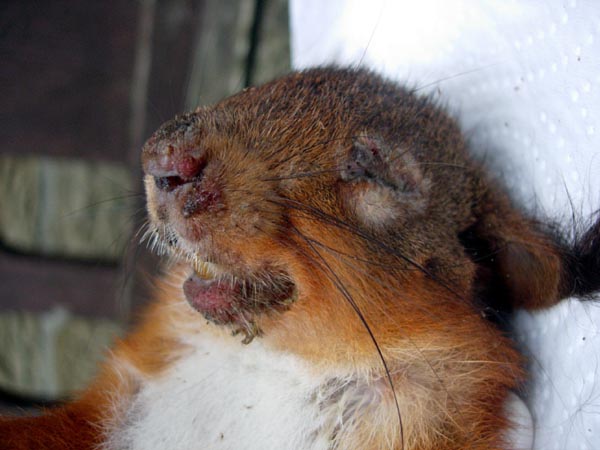
The disease is almost always fatal to Red Squirrels. It causes lesions around the mouth, nose and eyes similar to Myxomatosis in Rabbits and usually kills the squirrel in 7 to 10 days.


Click the link below to read the rest of the story.


The squirrel pox virus (squirrel parapoxvirus) is believed to be transmitted from grey to red squirrels by parasites in dreys and by contact at feeding sites. 

Because of the latter, people are being advised not to provide squirrel feeders in areas where red and grey squirrels are both present.

Read a full report about this by clicking the link below.

Lesions to the eyes, nose and mouth of a red squirrel, caused by the squirrel pox virus

Saturday, 19 March 2011

Glen Affric Squirrel Survey Map Update


I've just loaded this updated map to the
Glen Affric Squirrel Survey Page

My initial aim is to establish presence/absence of Red Squirrels across the area which is currently under recorded and officially listed as sparsely populated.

This is clearly not the case as shown by the areas that I have so far covered. In February I searched further south west beyond Hilton and Plodda Falls, and everywhere there is suitable habitat and food supply I have found recent evidence of occupation.

In the last couple of years there has been considerable felling of trees to the east of Hilton which has dispersed Squirrels into surrounding areas, particularly the mature Norway Spruce to the east of Plodda Falls.


2010 was my first year in Glen Affric so I can't make comparisons with previous observations but in this area Red Squirrels are predominately feeding on Norway Spruce and Larch.

Seasonal crops are Hazel and Beech in the autumn, plus green Norway Spruce, Douglas and Scots Pine cones throughout the summer.

Fungi, fresh shoots etc. are eaten when available and occasionally Sitka Spruce cones.


Squirrel presence is governed by suitable habitat, food availability and lack of disturbance and I believe that further observation will prove them to be present across the whole of the Glen Affric area where these conditions exist.

Unfortunately, because they spend a large proportion of their time in the crowns of Norway Spruce they are not often seen and Dreys are mostly invisible. They become more obvious in the autumn when there are young Squirrels dispersing and also when there is a general movement towards roadside hazel crops.

Images: Middle - Larch
            Bottom - Norway Spruce

Sunday, 30 January 2011

New Squirrel Survey area

I've established presence and distribution over the area I've been surveying this last year and I'm moving on to the next section of forest.

This is an area of about 360 Hectares consisting of a wide mix of tree species with plantations ranging in age from approximately 5 to 30 or 40 years with some clear fell and also old Scots Pine forest.

Elevation is generally between 200 and 300 metres and presents a fairly wide range of habitat from a squirrels point of view.

The images to the left show an area at about 250 metres which is fairly open with a heath understory
and old pine remnants of the original Caledonian forest.

Other parts are dense with a mix of mainly Birch and a lot of self seeded conifers such as Sitka Spruce. This density of undergrowth makes it difficult to find possible feeding signs on the ground and I'm going to employ a new technique for establishing squirrel presence which I will elaborate on at a later date, when I have some early results.  

Friday, 14 January 2011

Squirrel Tracks

After a fresh fall of overnight snow I was out last Sunday and came across this jumble of tracks on a forest road.

They were left by a pair of Red Squirrels mating. The first image shows where they mated and the second image shows where they moved away together and then split off in separate directions.

Squirrels leave a set of four prints in each group on a trail, that fill a square no more than 150 mm. For anyone not familiar with their appearance the third image shows such a group. The footprints widest apart are the hind feet and the two closer together are the fore feet. The Squirrel is moving in the direction of the hind feet because when the Squirrel hits the ground it lands on its fore feet and brings its hind feet in front for the next jump.


Friday, 7 January 2011

ProStalk trail camera problem

After another two days in the forest, set to shoot videos with a fifteen second delay, the camera worked OK but still will not operate correctly when set to a shorter delay time. I had a word with the importers and they've asked me to send it to them for evaluation of the problem.

Not much more I can do about this until they've had time to look at it, so for the time being my monitoring is on hold.

Hope to start making some Squirrel feeders next week, and will be using them in conjunction with trail cameras to try and determine presence/absence in areas which are difficult to survey by looking for signs. It's a bit of an experiment but I'm sure it will work.

Saturday, 25 December 2010

Trail Camera

I started to experiment with a trail camera a few months ago but what with moving house and fixing the van I didn't get time to do anything serious with it until recently.

Last Thursday I got it out in the forest in an area where I'm  surveying Red Squirrels, using Peanuts and Sunflower seeds as ground bait.

Nothing happened on Thursday but at 0543 on Friday a Brown Hare passed by and was caught on IR.


Nothing else until 0610 today when a Pine Marten arrived and spent about 12 minutes making a pig of itself.


Then at 0829 a Red Squirrel turned up briefly and shot up a Norway Spruce about 2 minutes later and wasn't seen again. What suprised me was how soon after first light it appeared. At this time of the year and at the sub zero temperatures we've had for over a week now I would have expected it to be foraging a bit later in the day. I think maybe there was still Pine Marten scent hanging around which is probably why it didn't stay or return.


At 1042 a suprise visitor was this Jay which stayed for about a minute.


No more after that until I collected the images at about 1430.

I've left more bait and will be going back in a couple of days.

All the images are shown original size with cropping. I'll talk more about trail cameras at a later date.

Monday, 20 December 2010

A hell of a year in paradise

I don't know why but every time I move home it seems to trigger a period of snow. It's exactly a year since I moved to Culbokie Cottage and now I've just moved a mile down the road by the village; and each time winter hase arrived with a vengeance. Happily, this time I'm by the tarmac and can get in and out, just!

Now I've got a telephone and internet access, so there's no excuse for not replying to emails and keeping the blog up to date.

I'm making a few changes to the way I do stuff online, most notably the website is going and all the prints for sale will now be available from Wildlife and Countryside Services . I'll now be using most of my time to continue with the Red Squirrel Survey and Photography; and I'll be posting regularly here and on the Red Squirrels of the Highlands  website, among others for which I'll provide links as they happen.

I managed to get a reasonable amount of survey work done this last Autumn and I've just started to experiment with tracking in the snow to build up a better idea of distribution in a typical forest plantation nearby. It will be interesting to see how the results tie in with the autumn survey.
Related Posts Plugin for WordPress, Blogger...
This web site is about the wildlife, particularly the mammals, of the Glen Affric National Nature Reserve area in the north west Highlands of Scotland, UK; and the equipment I use to search for them, which is chiefly trail cameras.

I provide a technical support and parts service for the Ltl Acorn range of cameras and the income from this provides for the upkeep of this site and the purchase of cameras for my own surveying.

I hope you find the site useful and informative; and please contact me if you have any questions that I haven't already covered.