Please do not use "post comments" to ask for camera help and advice.
Use phone, Skype IM or eMail.

Showing posts with label 940nm. Show all posts

Saturday, 14 June 2014

Ltl Acorn 850nm, 940nm, 24 and 44 Infra Red (IR) LED arrays compared.

Fig 1:  5210A with 24 IR LED Array
Following on from my previous post which compared the FOV of the new Ltl Acorn 5310 standard and wide angle lens models, this post illustrates the differences in appearance and performance between the old and new infra-red (IR) LED arrays.

Up to now all the Ltl Acorn camera models have used a 24 LED IR light source as shown in figures 1, 2 and 3. Figure 1 shows the 5210A with 24 blue LEDs which emit light in the 940nm wavelength. These LEDs are covert and do not glow when operating.

Figures 2 and 3 show the 24 LED 850nm and 940nm versions. The white LEDs emit light in the 850nm ( nanometer ) wavelength and can be seen to glow red when viewed straight on during operation. They are visible up to 10 plus meters distance and although the IR light emission has double the range of the 940nm version they are not suitable for use in situations where the camera may be vulnerable if observed, such as security applications.

Acorn have now released their 5310 series cameras using their newly developed 44 LED array which doubles the night time light

Saturday, 18 August 2012

Ltl Acorn 6210 Firmware Upgrade - Night time infra-red lighting and exposure.

Fig 1:  Pre update image from a recent 6210MMX
ISO 600    1/15sec   f2.8
In older models of the 6210 940nm series trail cameras, the night time images and videos were just about workable but grainy. After a number of complaints Acorn published a new software version, V1.1.003T in the camera I tested.

Unfortunately the correction overcooked and fig 1 shows a typical image.

Happily there's now a firmware update FW6210.bin (software version V.1.1.006u) to correct this, which produces an acceptable result as shown in fig 2.

I've also compared this with an image (fig 3) from an 850nm camera.

Thursday, 7 June 2012

Infra Red Night Image Quality and Illumination Range

Fig 1. 6210MC - Daylight reference image at ford
River Ford Site.
I chose this site to illustrate image contrast because of the temperature range it represents from very cold water (black) to the badger's body heat.

The tree to the right of the waterfall has retained a fair amount of heat whereas the rock face to the left is much cooler.

Figures 2 to 2b show the difference an equal change less (2a) and more (2b) in contrast makes. Less contrast equals more information within the limits of the technology.

Sunday, 26 February 2012

Ltl Acorn 6210 MC and Bushnell 119467 - Review - Part 4

Back to Part 3 - First Impressions and Case design

Fig 20  Bushnell 119467 showing main PCB and the
back of the IR LED Array at top left
Infra Red LED Arrays and Power Consumption:


Following on from the last part of this review, I wanted to quickly compare how the two different approaches to achieving invisible or no glow IR LED's impacted on battery performance, and coincidentally find out how the cameras performed at low temperatures.


Test conditions and set up: 
Each camera powered by 4 New Energizer Industrial Alkaline cells each measuring 1.62 volts.
SanDisk SDHC 4GB memory cards.
Cameras set on time lapse to take

Tuesday, 3 January 2012

Roe Deer investigating Birch Bracket Fungi

Just over a year ago I came across this Birch log with bracket fungi which were being eaten by animals unknown. At the time all the fruiting bodies had been reduced almost to a stump.

I left a camera over them on the off-chance that I would capture an image of whatever was responsible and although squirrel, badger and pine marten visited the log, none were observed feeding.

Visiting again this year I found many more fruiting bodies but so far, little evidence of feeding.

This time I seem to be ahead of the game so I set up another camera four days ago, in the hope that it will confirm what animal or animals are feeding on these brackets.

I checked the camera today for the first time and discovered that a roe deer had visited and sniffed at the fungi, but without feeding, a little over an hour before I arrived.

The camera is set to shoot a jpg file and then a thirty second video without a trigger delay. Left shows the deer heading to the log and two seconds later the video below shows it nosing at the fungi before moving away again.

Maybe the fungi are not quite right for eating yet or maybe its another animal responsible, but whichever, the camera will stay on site until I have an answer.


Sunday, 9 October 2011

Trail Camera Reviews


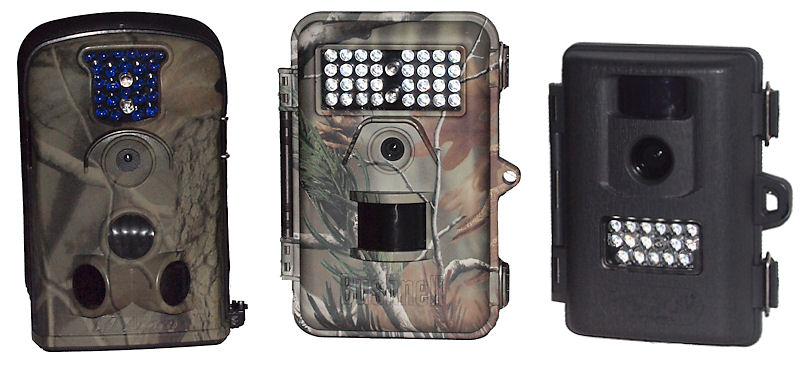
I've been intending to review the trail cameras that I've been using and while I'm without transport seemed like a good time to start. These cameras are, left to right an Acorn 5210A 940nm, a Bushnell Trophy Cam 2010 model 119445 and a Hawke ProStalk PC2000.


Ltl Acorn 5210 940nm

The Acorn is what they call a lo glow version; and means that it's IR diodes emit at a wavelength of 940 nano metres which is invisible to humans and wildlife.

Shown left with the back removed to access the colour viewing screen (48 x 35.69mm / 2.36"), key pad and additional battery compartment, this design is a departure from the more usual "peli" style cases used by Bushnell et.c


Bushnell Trophy Cam 2010 model 119445


The IR diodes emit a visible glow but they also have  2011 Black LED models 119466 and 467


This model has a black and white (24 x 32mm/ 1.5") display which can be used for camera set up but not for viewing what's on the card. You have to carry a separate viewer for this or wait until you have access to a PC.

The 2011 Black LED model 119467 does have a (32 x 42mm / 2") colour viewing screen.


Hawke ProStalk PC200


This camera is the smallest and lightest of the trio and again its IR Diodes produce a visible glow.

The black and white LCD display screen allows set up of all the cameras functions, but no viewing of images or video.

It is an extremely compact, functional and easy to use design.


There will be more about these cameras over the next few weeks, together with comparison tests and plenty of examples of field results in all modes and conditions.

All of this will be added to the trail camera page along with specification sheets and analysis.
Related Posts Plugin for WordPress, Blogger...
This web site is about the wildlife, particularly the mammals, of the Glen Affric National Nature Reserve area in the north west Highlands of Scotland, UK; and the equipment I use to search for them, which is chiefly trail cameras.

I provide a technical support and parts service for the Ltl Acorn range of cameras and the income from this provides for the upkeep of this site and the purchase of cameras for my own surveying.

I hope you find the site useful and informative; and please contact me if you have any questions that I haven't already covered.