Please do not use "post comments" to ask for camera help and advice.
Use phone, Skype IM or eMail.

Showing posts with label trail camera. Show all posts

Monday, 29 October 2012

Ltl Acorn 6210 Water Resistance Tests


Ltl Acorn 6210MMX
Don't all die of shock. This is what we've all been waiting for.
A 6210 with a water tight case.

Camera under test: 


Ltl Acorn 6210MG S/N 202001037 – This test camera is the re-designed case as of October 2012

Purpose of test: 


To determine its resistance to water ingress during heavy rainfall with at least a ten degrees centigrade drop in case temperature during the first five minutes from the start of the test.

Reason for test:


The camera case is a sealed unit at normal air pressure but with any sudden drop in external case temperature (e.g. cold heavy rain following heating by sun), the air inside starts to contract and form a vacuum. As the vacuum increases any weakness in the case seals will cause the seal to break down at some point and

Tuesday, 3 July 2012

Ltl Acorn 6210 water resistance tests update

Acorn 6210 water/condensation problem update 07.07.2012

I'm very happy and relieved to be able to say that the reason for the condensation problem in the Ltl Acorn 6210 Trail Camera has been identified.

After lengthy tests and analysis the cause of water getting into the control panel is, at long last, understood; and some final changes to the case upgrade are now being made.


I don't know exactly how long this will take, but it will be as fast as possible.

I will post a full explanation of the problem and how it was solved at a later date. Users of cameras which have this problem should remove the rubber bung (external power supply input) from the base of the camera.
...................................................................................................................................................................


Fig 1:   Ltl Acorn 6210 HD Series trail camera
Left: Modified version  Right: Old version
I'm a little disconcerted to find retailers offering the updated version of this camera for sale when I'm still conducting water resistance tests on the modification.

This is a little premature as the unit I'm testing is still taking in water; so if you are offered an updated - waterproof - camera at this stage, think  before buying.

Acorn have made a lot of improvements to the existing design as illustrated in figures 1 and 2; but then they send me a unit to test with damage to the sealing lip (figure 3 arrow 1) and more damage caused by tooling marks (figure 3 arrow 2)
(figure 4 arrow 1)

In theory the design changes should prevent water

Thursday, 21 June 2012

Trail Cameras - New Ltl Acorn 6210 water ingress tests

Acorn 6210 water/condensation problem update 07.07.2012

I'm very happy and relieved to be able to say that the reason for the condensation problem in the Ltl Acorn 6210 Trail Camera has been identified.

After lengthy tests and analysis the cause of water getting into the control panel is, at long last, understood; and some final changes to the case upgrade are now being made.

I don't know exactly how long this will take, but it will be as fast as possible.

I will post a full explanation of the problem and how it was solved at a later date. Users of cameras which have this problem should remove the rubber bung (external power supply input) from the base of the camera.

...................................................................................................................................................................
Fig 1:  The new, modified
Acorn 6210 (MMX version)
Dripping wet after its first
water ingress test.
The long awaited camera has arrived and is pictured on the left, following its first rudimentary water ingress test.

Change to the case design
This camera is rated IP54 which means limited dust ingress protection and protected against water spray from any direction. It is not rated as waterproof; as is no other camera of this type, as far as I'm aware.

To overcome an earlier problem with water getting into the control panel, located in the bottom door, the manufacturers have redesigned the case and door (see figures 3 and 4). These tests are to evaluate the effectiveness of the changes. I'm hoping to complete the tests in about four days.

First test results
During this first test the camera was subjected to a twenty litre shower and then left to stand for 30 minutes; after which it was dried off externally and opened up to check for any water inside.


Wednesday, 14 March 2012

Pine Marten v Wood Mouse

Pine Marten
After returning from my trip south, I've been collating and analysing results from the test cameras.

The image on the left (750 x 820 pixels) is cropped from a jpg file (2560 x 1920 pixels)  taken on an Acorn 5210A

The rather amusing video composite below is from the Bushnell and was taken prior to the trip, but I didn't get time to put it together before leaving.

I have no idea if the Mouse survived but others have been seen since.

Today I'm relocating some of the survey cameras and checking others for any results. before continuing with the review.

More in a couple of days.


Sunday, 4 March 2012

Pine Martens Mating

I'm going to be away for a week, so this will be my last post until I return.

This video is a composite of three short clips from the Ltl Acorn 6210MC which I have on test, along side the Bushnell black flash camera trap.

The Acorn is mounted just above the Bushnell and the sudden increase in IR light level is caused by the Bushnell switching on. These cameras produce approximately the same amount of illumination, so this is a good example of the gain when doubling the amount of light source. The trees in the distance are about 45 feet (15 meters) from the cameras.

I don't know if I'm imagining this, but at the second light increase during copulation, both animals momentarily froze as if they were reacting to it. These trail cameras are both black flash so this has got to be a coincidence, hasn't it?. It did make me wonder though.


Monday, 20 February 2012

Ltl Acorn 6210 MC and Bushnell 119467 - Review - Part 3

Back to Part 2 - First Impressions and Case design

Fig 10 Energizer Industrial AA Alkaline cells
used during camera tests and evaluation
Batteries and Power Supplies:


In part 2 of this review I complained about the design of the battery compartment in the Bushnell, which on reflection, was not entirely justified.


The battery cells are loadable without the cross bar being removed, as shown in Fig 11. It's still a 
Fig 11 Inserting cells into the battery case of a 
Bushnell Model #119467
bit of a fiddle, especially when removing them, but it does work.


Acorn 6210   Internal cells are arranged as three
sets of four (Fig 12). Each set is isolated from and in parallel with the others. The external DC input is a fourth isolated circuit, also in parallel with the other three circuits.

The camera will operate with just four cells in any one of the circuits or an external DC power source of 6 to 12 volts plugged (see Fig 13) into the DC input socket. Use an external battery pack or a solar panel. The centre pin is positive polarity.

Be certain to observe the correct polarity, as indicated on the inside of the battery covers, when inserting cells
Fig 12 Acorn 6210 internal battery circuits numbered 11 22 33
 Sets of 4 x AA cells 

Because the circuits are isolated and in parallel, if any set of cells in one circuit is at a lower charge, they will not drain power from the other sets.


When all battery cells are removed the Acorn is able to retain time and date settings long enough to change batteries but with the Bushnell these will be lost. Keep one set of cells in place while you change the others to avoid having to reset the time and date.

Bushnell 119467   The arrangement of power circuits (see Fig 12a) is basically the same as the Acorn 6210 except that it can only use a 6 volt 
external supply.

Monday, 30 January 2012

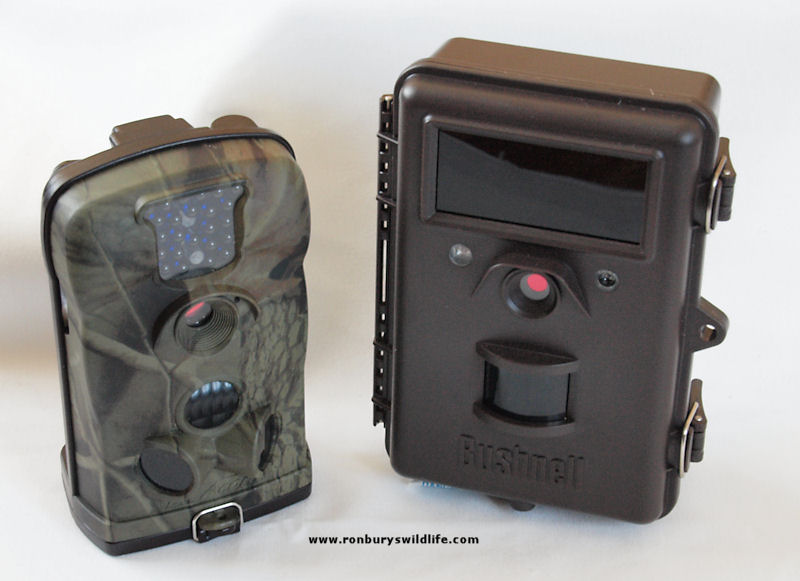
Ltl Acorn 6210 MC and Bushnell 119467 - Review - Part 2


fig 1  Left: Acorn 6210  -  Right: Bushnell 119467


First impressions: Having been conditioned to the Peli case style box of many trail cameras, I initially thought the Ltl Acorn 5210 was a bit quirky; but having used them for a while, I found the design quite practical.


The first incarnation of the 6210 was basically the upgrades in the 5210 box. Then for reasons unknown, the manufacturers did a complete redesign of the whole package whilst keeping the front design almost unchanged but with a slight increase in width and depth.


Fig 2  Ltl Acorn 6210MC


It's likely that the need to accommodate the extra set of four batteries, coupled with a desire to move away from the detachable back sponsored the changes. Whatever the reasons, I couldn't help but be impressed with the ingenuity with which the designers put so much into such a small unit and kept the weight down as well.

From a user point of view, the smaller and lighter the better, and I also felt that, with its bottom opening door the Ltl Acorn 6210 was going to be a lot more weather proof than its predecessor; and all the other front opening trail cameras such as the Bushnell.

Fig 3
Water ingress of the
Ltl Acorn 6210 LED array

I then received the news that one of these cameras had water inside the LED array (Fig 3) after only a few days outdoors; which is a serious issue and not something I wanted to hear at this stage

It could most likely be an ineffective seal where the array mates to the inside of the case front; but

Wednesday, 25 January 2012

Ltl Acorn 6210M HD Video Series User Manual

Download manual
This is a pdf file of the user manual for the new Ltl Acorn Trail Camera Ltl 6210M which is now available.

I'm about to do a review of this camera and prior to its arrival I looked on the web for a copy of this manual without success; so I decided to produce my own.

There is a pdf user manual of the test series version of this camera but this is the up to date version. Useful if you're trying to make your mind up about a purchase.
Note: This camera is the real deal and not a clone.

Click here to view or download the manual

Tuesday, 3 January 2012

Roe Deer investigating Birch Bracket Fungi

Just over a year ago I came across this Birch log with bracket fungi which were being eaten by animals unknown. At the time all the fruiting bodies had been reduced almost to a stump.

I left a camera over them on the off-chance that I would capture an image of whatever was responsible and although squirrel, badger and pine marten visited the log, none were observed feeding.

Visiting again this year I found many more fruiting bodies but so far, little evidence of feeding.

This time I seem to be ahead of the game so I set up another camera four days ago, in the hope that it will confirm what animal or animals are feeding on these brackets.

I checked the camera today for the first time and discovered that a roe deer had visited and sniffed at the fungi, but without feeding, a little over an hour before I arrived.

The camera is set to shoot a jpg file and then a thirty second video without a trigger delay. Left shows the deer heading to the log and two seconds later the video below shows it nosing at the fungi before moving away again.

Maybe the fungi are not quite right for eating yet or maybe its another animal responsible, but whichever, the camera will stay on site until I have an answer.


Monday, 2 January 2012

Hooded Crows and Jays at bait - Remote camera in mid December

Hooded Crows (Corvus corone cornix) - Moon phase, date and time are incorrect

Jays (Garrulus glandarius)   - Moon phase, date and time are incorrect   


Friday, 14 October 2011

Wildlife reactions to trail cameras

Following on from the last post, I had the ProStalk set up over peanuts in the same area and as well as the squirrel, this was visited by badger and pine marten.

The video clip below shows a badger taking notice of the visible infra red when the camera switched on. Badgers and pine martens don't seem at all bothered by this and after their initial interest, will carry on as normal. Almost invariably, pine martens will come and give the camera a close up inspection and on a number of occasions where the camera has been set close to the ground, they have marked the camera by urinating over it. The first time this happened I thought the camera was a bit sticky when I went to check the card, and afterwards, as I looked at the video clips, I realised why.

This is not the case with other wildlife. Red Deer will always be nervous and shy away from the camera if they come close or it is directly in their path. Urbanised foxes, although nervous, do seem to tolerate the IR glow after a while, but out here where foxes are really wild, all you'll usually see is the light in their eyes as they keep to the edge of the illuminated area and skirt round and away.


Close by another camera caught these Red Deer hinds and I think a yearling calf, in the early morning light.

Friday, 26 August 2011

Deer at Corrimoney RSPB Reserve

Collection of trail camera clips of Roe and Red Deer at three separate locations on the reserve between the 8th and 26th of August 2011


Monday, 18 April 2011

Red Deer Hind spooked by infra-red LEDs on trail camera.

I moved the trail camera from the Badger Sett a few days ago to investigate a couple of deer trails and this clip is one of the early results.


This Red Deer Hind was heading towards the trail camera in early morning light; which wasn't bright enough to prevent the infra-red illumination from switching on. Like Foxes, Deer seem to be made very nervous on sight of the red glow from the LEDs.

Badger chasing Pine Marten

Sorry for the recent lack of posts. I've had a visitor for a couple of weeks and I'm also getting the van ready for it's MOT.

This recent trail cam clip from the Badger sett shows that Badgers don't always tolerate Pine martens.


This Pine Marten was close to the sett entrance and the Badger chased it away. I think there may be cubs in this sett and the adult is never far away at the moment.

Sunday, 3 April 2011

Who's living in this hole

At another forest location is an old disused Badger Sett which I've been keeping an eye on, and recently there has been some fresh digging at one of the entrance holes. This last week I decided to stake it out with the trail camera and see what might be visiting.

On the second night the hole was investigated about two hours apart by a Pine Marten and a Badger. Both animals entered the hole briefly but neither stayed for more than a few minutes.

There were no false triggers on the camera to suggest that anything had exited the hole and disappeared during the camera delay time and neither animal stayed long enough to indicate anything other than a passing interest.

For the moment I can only assume that the fresh digging is exploratory. Curiously a Fox was caught fleetingly at the edge of the light, just after 9pm on the third night, and as is usual with Foxes, was spooked by the IR. The slightest suggestion of anything out of place and the local Foxes just melt away. Again nothing to suggest it was using this hole as I would have expected it to be out earlier if it had been exiting the hole after laying up. Mind you, I still have a question mark over this as the delay time on the camera would miss a fast exit.

Just after 3pm on the second day the camera was triggered by Chaffinch's feeding on the ground around the entrance. Suddenly they were spooked by something and took off in a great hurry after which a wing briefly appeared in the right hand side of the frame. I've looked at this several times and I'm fairly certain it was a hunting Sparrowhawk but there's not enough visible to make posting the video clip worthwhile.

It did leave me wondering how often trail cameras catch this sort of event, especially as in this case, in a confined forest environment.

I've now moved the camera back to the other Sett where I'm hoping young will emerge during April but will check this hole from time to time.

Below is a brief clip of the Marten and Badger.


Who's living here from Ron Bury on Vimeo.

Friday, 1 April 2011

Using a ProStalk PC2000 Trail Camera indoors

More on using the ProStalk at close quarters without over exposure.

I'm still experimenting with this and have found that battery charge state exacerbates this issue so that a filter/diffuser that works OK when the batteries are fully charged will progressively reduce the light too much as they are discharged.

It works for a while though.
See this link for another users solution.
Making the Net Work....: Using a Trail Camera indoors

Saturday, 26 February 2011

What a wonderful day

I've not long been back from the forest where it's 6C, sunny and really feels like spring. Yeh, I know, we've still got March to come but I'm not going to let that thought spoil my mood.

Just relocated the trail cam to a Squirrel feeder for the day and will return it to the Badger sett tonight.

The night before last I had two Badgers on camera together and I've managed to convince myself that the one I see regularly is a sow with cubs underground.

I hope the second Badger is a male and they might perform on camera.

The view of the trail cam at left is to show the diode masking I've used to reduce the light in the middle of the image area. It was burning out all the detail because of uneven light distribution and this mod' seems to have worked pretty well.

I'll try and get the video footage from two nights ago sorted out and loaded later on today.

Talking of spring, I'd been to an outlying two hole sett
this morning to see if there was any sign of activity (non at the moment) and I was on my way back along a forestry track, when I nearly put my foot on a Common Newt.

This little feller is about 10cm long and must have just come out of hibernation, He looked like a bit of tree debris at a distance and was lucky I didn't put my boot on him.

The sun had gone behind cloud and with the ground still fairly cold he wasn't moving. I managed to coax him onto my hand and within a minute he was starting
to perk up. It's amazing how quickly they absorb heat.

I left him on the side of the track, out of harms way and waiting for the sun to come back out. I hope he has a good year.

So that's today so far. We'll see what the trail cam has to show later this afternoon.


Saturday, 25 December 2010

Trail Camera

I started to experiment with a trail camera a few months ago but what with moving house and fixing the van I didn't get time to do anything serious with it until recently.

Last Thursday I got it out in the forest in an area where I'm  surveying Red Squirrels, using Peanuts and Sunflower seeds as ground bait.

Nothing happened on Thursday but at 0543 on Friday a Brown Hare passed by and was caught on IR.


Nothing else until 0610 today when a Pine Marten arrived and spent about 12 minutes making a pig of itself.


Then at 0829 a Red Squirrel turned up briefly and shot up a Norway Spruce about 2 minutes later and wasn't seen again. What suprised me was how soon after first light it appeared. At this time of the year and at the sub zero temperatures we've had for over a week now I would have expected it to be foraging a bit later in the day. I think maybe there was still Pine Marten scent hanging around which is probably why it didn't stay or return.


At 1042 a suprise visitor was this Jay which stayed for about a minute.


No more after that until I collected the images at about 1430.

I've left more bait and will be going back in a couple of days.

All the images are shown original size with cropping. I'll talk more about trail cameras at a later date.
Related Posts Plugin for WordPress, Blogger...
This web site is about the wildlife, particularly the mammals, of the Glen Affric National Nature Reserve area in the north west Highlands of Scotland, UK; and the equipment I use to search for them, which is chiefly trail cameras.

I provide a technical support and parts service for the Ltl Acorn range of cameras and the income from this provides for the upkeep of this site and the purchase of cameras for my own surveying.

I hope you find the site useful and informative; and please contact me if you have any questions that I haven't already covered.